

Share this
by Sarah Basiri on 22/May/26
When input costs are high, soil biology data can help growers understand what is happening below the surface and make more confident fertility, product, and management decisions.
Farming has become a game of expensive decisions.
Every fertilizer application, biological product, crop protection pass, and management change has to work harder when input costs are high and margins are tight. The challenge is that many of these decisions are still made without a clear view of what is happening below the surface.
Traditional soil testing is essential. It shows what nutrients are present, where pH may be limiting availability, and what physical and chemical conditions are shaping your fertility plan. But it does not always explain why two fields with similar fertility programs can deliver very different results.
That missing layer is soil biology.
The microbes living in your soil (and no matter your soil, they are there by the trillions) influence whether nutrients become available to the crop, get tied up, or are lost from the system. By measuring those biological pathways at the field level, growers and agronomists can make more precise decisions about where to invest, where to adjust, and where spending more may not be the best answer.
That is where the ROI of soil biology begins: not in testing for the sake of testing, but in improving the decisions that protect yield, reduce waste, and support profitability.
Here are five ways soil microbial data can help protect farm margins.
1. Avoid spending more before you know the real constraint
When a crop underperforms, one of the first instincts is often to add more fertility. But if the underlying issue is biological, more fertilizer may not solve the problem, or may not deliver the return you expect.
Most nutrients do not move directly from fertilizer to crop uptake in a straight line. Crops don’t interact with nitrogen in the abstract. They interact with nitrate, ammonium, urea, and amino acids, etc. Microbes govern the forms nitrogen takes in the soil by converting air and organic matter into ammonium, ammonium into nitrate, ammonium and nitrate into organic forms, nitrate into gas, etc. Similar biological pathways affect phosphorus and potassium availability.
That means two fields can have similar nutrient levels on a chemistry test but very different biological capacity to make those nutrients available to the crop, a central factor in nutrient use efficiency.
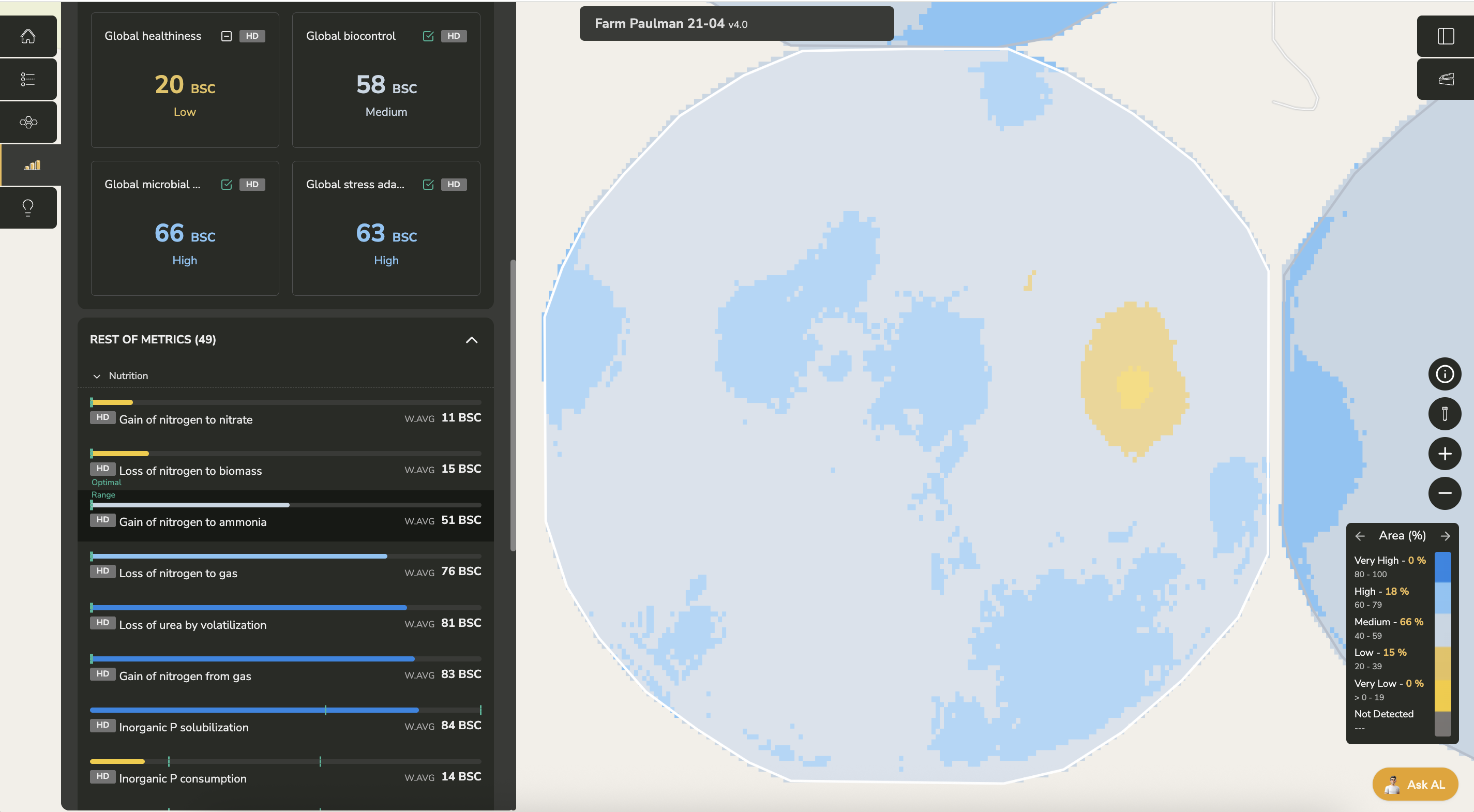
In BeCrop® Farm, growers and agronomists can use BeCrop® Indexes to evaluate the biological potential of the soil, including nutrient cycling functions related to nitrogen, phosphorus, potassium, as well as the potential to mobilize sulfur, calcium, magnesium, iron, zinc, manganese, copper, and chlorine.
Instead of looking only at what nutrients are present, BeCrop® Farm helps show whether the soil biology is supporting nutrient availability or creating a bottleneck that could limit input efficiency.
Margin protection takeaway:
Before increasing fertilizer rates, use BeCrop® Indexes to understand whether the issue is really nutrient supply, or whether biology is limiting how effectively those nutrients are made available.
2. Protect nitrogen investment by identifying loss risks earlier
For many growers, nitrogen is one of the most important input investments of the season. If nitrogen is being lost, immobilized, or poorly synchronized with crop demand, the issue is not just agronomic. It’s financial.
One of the most practical uses of soil biology data is identifying where nitrogen may be leaving the system or becoming unavailable before the crop shows visible stress.
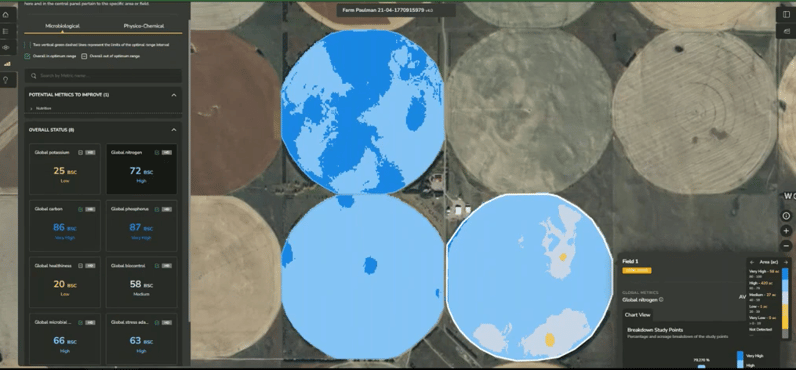
In BeCrop® Farm, the Global Nitrogen Cycle view helps break nitrogen cycling into specific biological pathways. This gives growers and agronomists more detail than a single overall score.
For example, BeCrop® Farm can help evaluate biological functions related to:
- Nitrogen fixation
- Nitrogen mineralization
- Nitrification
- Denitrification
- Urea volatilization
- Nitrogen immobilization
This matters because not every nitrogen issue is the same.
If nitrogen fixation or mineralization potential is low, the field may need support improving biological nutrient supply. If denitrification or volatilization pathways are elevated, the bigger concern may be nitrogen loss. In that case, the right next step may involve evaluating nitrogen stabilizers, enhanced efficiency fertilizers, biological products, humic substances, or changes in application timing and placement.
Margin protection takeaway:
Use the Global Nitrogen Cycle to understand whether your nitrogen strategy is aligned with what is actually happening in the soil, not just what was applied.
3. Use biology to explain why nutrient levels are low
A low nutrient reading on a chemistry test tells you there is a problem. Biology can help explain why that problem may be happening.
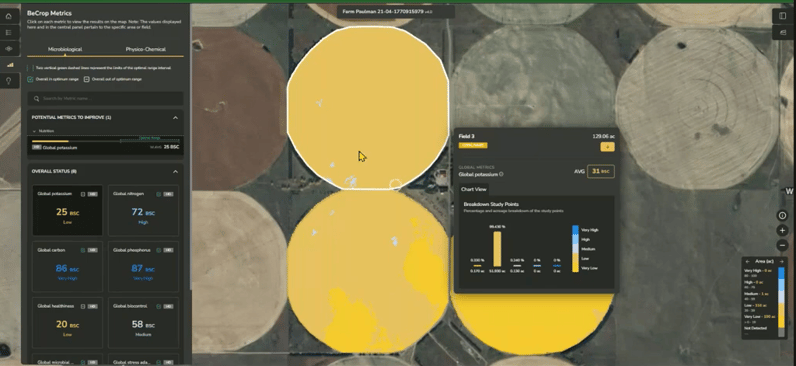
In one BeCrop® Farm example discussed during our recent webinar, several corn fields showed very low global potassium cycling scores. The biological data helped explain the issue: microbial potassium consumption was high, while potassium export to the crop was low.
In simple terms, microbes were using potassium, but the system was not effectively releasing enough of it in a plant-available form.
The chemistry test also showed lower available potassium in the field with the highest microbial potassium consumption. Taken together, the biology and chemistry data suggested that simply adding more potassium completely misses the underlying issue.
That is an important distinction. If the issue is only viewed as a low nutrient level, the likely response may be to spend more on fertilizer. But if biology shows that nutrients are being tied up or poorly cycled, the better decision may be to adjust the source, timing, placement, or supporting management strategy.
Margin protection takeaway:
When chemistry shows a nutrient gap, soil biology can help determine whether the next step should be more fertilizer, a different nutrient source, a biological strategy, or a management change.
4. Match products and practices to the field’s actual needs
Not every field needs the same product. Not every biological product is the right fit for every soil. And not every fertility issue should be solved with a higher rate.
Soil biology data helps narrow the decision.
For example:
- Low nitrogen fixation may point toward evaluating nitrogen-fixing biologicals, or to a failure of soil aggregation rendering such organisms ineffectual.
- Low phosphorus solubilization suggests the inoculation of such microbes is more likely to measurably improve bushels per pound of applied P..
- Elevated nitrogen loss pathways points toward greater value in retention and stabilization strategies.
- Weak potassium export, especially in 2:1 clays like Montmorillinite, points us toward Bacillus inoculation or stimulation nutrient cycling through microbially-available carbon sources.
- Disease risk indicators and microbial capacity for disease suppression may help prioritize fields for crop protection planning, while forgoing needless expense on low risk fields.
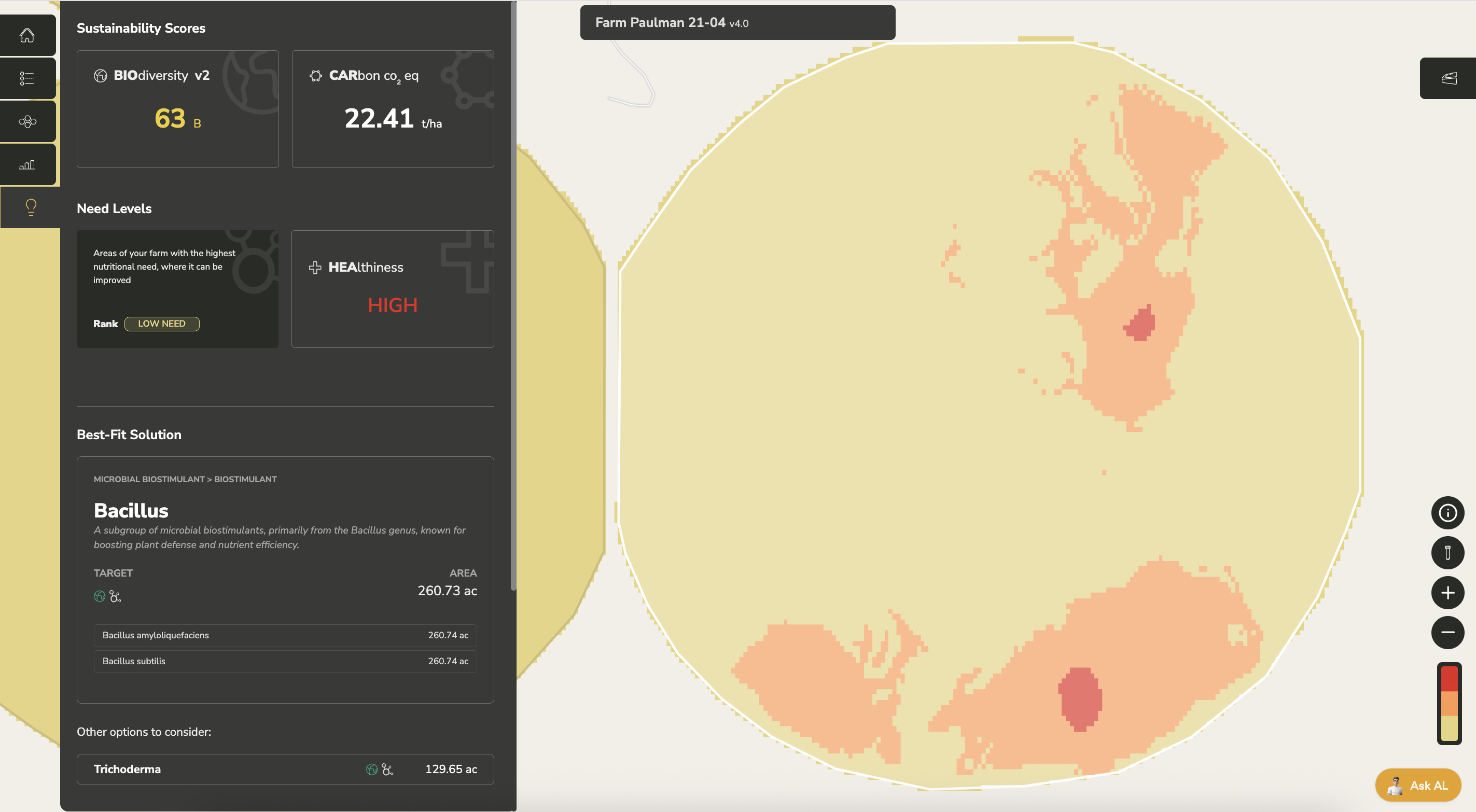
In BeCrop® Farm, insights from soil biology can help connect field-level needs to more targeted product and practice decisions. Instead of applying the same approach across every acre, growers and agronomists can use biological data to better understand where a product may fit, where it may not be the first priority, and where another management strategy may create more value.
The goal is not to create a one-size-fits-all recommendation. The goal is to match the right product, practice, or fertility strategy to the right field condition.
Margin protection takeaway:
Use biological insight to make product selection more targeted, rather than relying on broad recommendations across every acre.

5. Prioritize input decisions with the greatest return potential
When margins are tight, every input decision needs to earn its place. Consider this case study:
An inoculum of Methylobacterium symbioticum was tested at five, distinct Midwestern locations using the BeCrop® Trial protocol plus yield data. Across those five trials, 75% of the variability in yield was explained by an accompanying improvement in the BeCrop® Global N score, an assessment of the soil’s tendency to biologically supply crop-available nitrogen. In other words, the inoculum enhanced biological nitrogen cycling by 11.58 points on average, which was strongly predictive of yield improvement, which averaged 8.76 bu/ac.
Now consider this Midwestern farm tested through the BeCrop® Farm service. These four pivots have an average Global N score of only 24, well below the optimal range of 60 to 100, pointing to limited nitrogen mobilization as a likely yield-limiting factor on this operation. If we apply the trial data above to address this clear shortcoming through inoculation of M. symbioticum, we would have grounds to predict positive ROI:
| Scenario: four underperforming corn fields, average Global Nitrogen BeCrop Score of 24 (optimal range: 60 to 100). A nitrogen-fixing biostimulant containing Methylobacterium symbioticum is selected based on the BeCrop diagnosis. |
| Avg BeCrop Score increase with M. symbioticum applied | +11.58 BCS |
| Expected yield increase at that improvement | 8.76 Bu/Ac |
| Revenue increase at $4.64/bu | $40.64 / acre |
| Cost of biostimulant application | -$18.27 / acre |
| Cost of BeCrop Farm | -$7.00 / acre |
| Net profit per acre | $15.37 / acre |
| ROI | 60.8% |
Results will vary by field, region, crop, product, and management conditions. But the larger point is clear: when biological data helps identify the right constraint, even a modest diagnostic investment can sharpen much larger input decisions.
The value of soil biology data is not just in the test itself. It is in the input decisions it helps improve.
Margin protection takeaway:
Use soil biology data to prioritize the decisions most likely to improve input efficiency, protect yield, and support profitability.
Why this matters now
Growers are under pressure to protect yield while managing rising costs. That does not mean cutting inputs blindly. It means understanding where inputs are most likely to work, where they may be underperforming, and where a different strategy may be needed.
Soil biology testing does not replace a fertility program. It makes those decisions more precise.
Knowing what your soil contains is a starting point. Knowing what your soil can do with those nutrients is where better decisions begin.
Make your next input decision with more confidence
When margins are tight, every input decision needs better evidence.
BeCrop® Farm brings field-level soil biology intelligence into practical farm management, helping growers and agronomists identify biological constraints, understand nutrient cycling, evaluate field variability, and prioritize the decisions most likely to improve input efficiency.
BeCrop® Farm is now even more accessible! Thanks to some recent updates to our Smart Sampling System, small and medium-sized farms can access high-reliability soil biology insights for an affordable fixed price.
Ready to explore what soil biology can reveal about your farm?
Or, if you'd like to dive deeper first:
Watch the on-demand webinar:
From Soil Biology to Fertility Decisions: A Practical Approach to Improving Nutrient Use Efficiency